.webp)
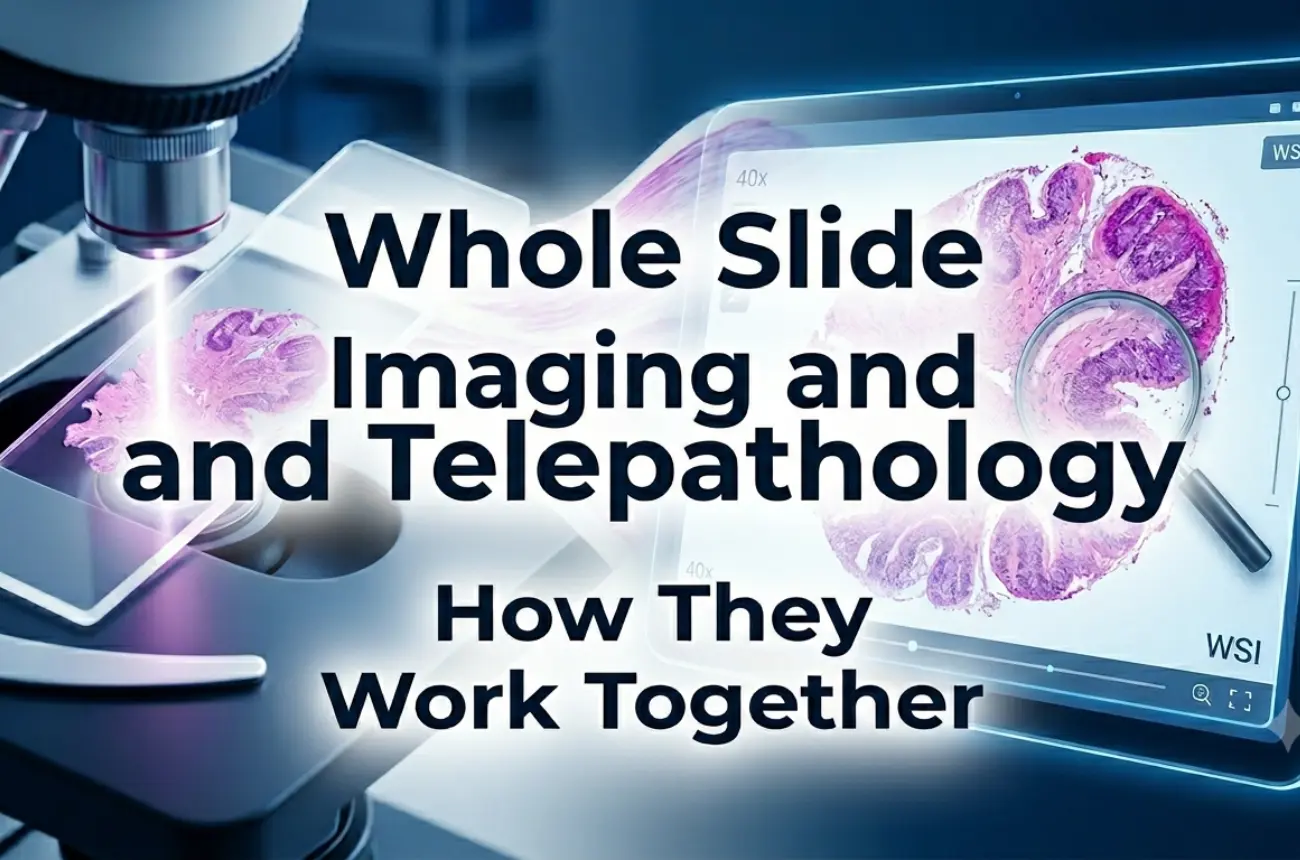
Whole slide imaging has fundamentally transformed pathology education by enabling simultaneous access to digital slides for unlimited learners, eliminating the constraints of physical microscopy and scarce glass slide resources. Educational institutions implementing best practices; curated teaching sets, interactive annotations, and standardized assessment protocols; report enhanced student engagement, improved diagnostic skill development, and equitable access to rare cases regardless of program size or geographic location.
This guide explores proven strategies for implementing whole slide scanning in educational settings, from undergraduate medical education through continuing professional development. You'll discover how to build effective digital teaching libraries, create interactive learning experiences, assess learner competency, and leverage technology to standardize pathology education across diverse training environments.
Effective digital pathology education begins with thoughtfully curated slide collections. Programs should develop teaching sets spanning the full diagnostic spectrum, including common entities, rare pathologies, normal tissue for comparison, and cases demonstrating diagnostic pitfalls. For undergraduate medical students and new trainees, clear examples with interactive labels aid identification of key features. Advanced learners require cases of increasing complexity that develop pattern recognition and diagnostic reasoning skills.
The transformative advantage lies in democratizing access to rare cases. Unique pathologies that might appear only sporadically in any single laboratory can be digitized and shared across programs, ensuring trainees at smaller institutions access the same quality material available at large academic centers. High-resolution digital pathology scanners generate large files, making compression technologies that preserve diagnostic quality while reducing storage footprints essential for extensive teaching libraries within budget constraints.
Static digital slides represent only the starting point. Interactive annotation tools create guided learning experiences that transform education. Annotations guide learners through complex specimens, while side-by-side viewing enables clinico-pathological correlation with radiological and clinical images. Digital slide software allows trainers to enable or block annotations for different users based on ability level; detailed guidance for beginners, minimal support for advanced learners, and testing their diagnostic capabilities.
Interactive elements extend beyond simple labeling. Embedded questions prompt learners to identify specific features before revealing answers, creating active learning rather than passive observation. Case-based learning modules simulate clinical workflows where students review patient presentations, order tests virtually, and examine tissue specimens within integrated platforms. These structured activities encourage deeper engagement than traditional slide review sessions.
Digital pathology enables a standardized assessment impossible with conventional microscopy. All examinees view identical slide preparations without variability from different glass slides or microscope optics. The American Board of Pathology administers computer-based examinations using 120 static digital images and 25 virtual slides, demonstrating integration into high-stakes certification processes.
Assessment design should reflect intended competencies. For pattern recognition, static high-power images suffice. For diagnostic reasoning requiring architectural evaluation followed by confirmation, whole slide scanners become essential. Formative assessment throughout training provides continuous feedback on progress, while competency tracking across multiple points documents trainee progression over time. Digital platforms automatically record response accuracy and time spent per case; data that informs personalized remediation and validates readiness for independent practice.
Implementation strategies vary by setting. Medical schools replace multi-headed microscopes with computer laboratories or individual device access, providing 24/7 access to unlimited slide sets without competing for scarce physical resources. Pathology residency programs balance digital education with hands-on microscopy skills, using automated microscope slide scanners for routine teaching while preserving conventional microscopy for specialized techniques like polarized light examination.
For practicing pathologists, continuing education maintains competency for quality patient care. Professional meetings increasingly use virtual slides for interactive presentations, while proficiency testing programs incorporate digital components. International collaboration opens unprecedented opportunities; educators in resource-limited settings access teaching materials from leading institutions globally, and subspecialty experts provide virtual lectures with curated digital slide sets, expanding educational reach beyond traditional geographic constraints.
Successful implementation requires appropriate infrastructure beyond the scanner. Network bandwidth must support multiple simultaneous users without lag. Viewing software should offer intuitive navigation with seamless zooming and panning. Display monitor quality affects outcomes; color accuracy ensures staining appearances match clinical observation, while adequate resolution prevents pixelation at high magnification.
Initial costs create barriers, particularly for smaller programs. Digital pathology scanner price varies dramatically based on specifications, though educational institutions may prioritize different capabilities than diagnostic laboratories. Moderate scanning speed suffices when building teaching libraries incrementally. Shared scanner arrangements between institutions reduce per-program costs, with regional consortia investing collectively and sharing cloud-based libraries.
Faculty resistance stems from unfamiliarity and perceived workload. Successful programs demonstrate workflow efficiencies; rapid presentation creation, instant slide sharing, and elimination of physical slide management. Quality control ensures teaching material meets standards with exemplary tissue preparation, appropriate staining, and clear diagnostic features. Poor-quality digitization with focus issues or color inaccuracy teaches incorrect morphologic patterns.
Structured curricula integrate digital pathology systematically from day one, normalizing the approach and building proficiency progressively. Active learning strategies require learners to annotate features independently, create differential diagnoses, or compare specimens side-by-side. Flipped classroom models work particularly well; students review curated slide sets before class, then use synchronous time for discussion and complex case analysis.
Continuous feedback loops improve teaching materials iteratively. Track which cases generate frequent questions or where students consistently struggle, then add clarifying annotations or create supplementary reference images. This data-driven refinement enhances clarity and effectiveness over time.
Educational institutions evaluating pathology slide scanner systems should prioritize image quality, particularly color fidelity and resolution, over scanning speed. Students learn pattern recognition from exemplary specimens. Educational software features deserve careful consideration: annotation tools supporting diverse use cases, assessment capabilities including embedded questions and automated grading, and learning management system integration that streamlines course delivery.
Scalability accommodates program growth, handling expanding slide libraries and increasing user numbers without performance degradation. For educational institutions seeking accessible entry points, solutions like Morphle Labs balance capability with fiscal responsibility. Their platforms achieve diagnostic-grade image quality at 0.22 microns per pixel while compact file formats reduce storage costs by approximately 75% compared to conventional formats, enabling extensive teaching libraries within realistic budgets.
Multiple scanner configurations accommodate institutions ranging from small teaching hospitals to major academic medical centers, maintaining consistent imaging standards across the product line to ensure teaching material quality remains uniform regardless of scanner model used.
Artificial intelligence integration represents the next frontier. AI algorithms can provide instant feedback on diagnostic accuracy, highlight frequently missed features, or suggest remediation cases based on demonstrated weaknesses. Virtual reality applications promise immersive experiences with three-dimensional tissue reconstructions, teaching spatial relationships impossible through two-dimensional images.
Crowdsourced annotation projects engage learners in content creation while building massive teaching resources. Student cohorts collectively annotate specimen features, with faculty validation before library incorporation. Gamification strategies, diagnostic challenges structured as competitions, achievement badges, or leaderboards, introduce motivational elements that sustain interest through repetitive practice essential for pattern recognition development.
The evidence supporting whole slide imaging in pathology education is definitive; properly implemented digital approaches deliver outcomes matching or exceeding traditional microscopy while providing accessibility, standardization, and scalability impossible with physical slides. Educational programs adopting best practices report enthusiastic learner reception, improved assessment standardization, enhanced collaboration across institutions, and expanded access to subspecialty expertise.
Enhance pathology education with whole slide imaging.
Explore how Morphle Labs supports digital teaching, assessment, and training workflows. Request a demo.


.webp)
.webp)
.webp)
.webp)
.webp)
.webp)