Whole Slide Imaging for Cytology: Best Practices

Cytology’s 3D cell clusters and uneven thickness demand advanced imaging. A whole slide imaging system for cytology must deliver precise focus, Z-stacking, and fast, high-quality scanning. The blog explains key terminology, the cytology scanning workflow, and technical factors like optics, compression, and AI readiness. It outlines benefits such as telepathology, teaching, QA, and research, along with challenges like larger file sizes. A buying guide highlights essential scanner features, and future trends include adaptive Z-stacking and AI-assisted focusing. Morphle’s high-speed, Z-stacking scanners are positioned as ideal for cytology digitization.
5 mins

Whole Slide Imaging for Cytology: Best Practices

TL;DR

Cytology presents unique imaging challenges; three-dimensional cell clusters, variable thickness, and the need for exceptional fine-detail resolution. A whole slide imaging system designed for cytology requires precise focus, advanced Z-stacking, and workflow-driven best practices. This article outlines technical, operational, and practical guidelines to ensure high-quality digitization of cytology slides using modern scanners and imaging tools.

What You’ll Learn

  • Core terminology related to cytology digitization

  • Workflow considerations when using whole slide scanning

  • Technical factors that affect image quality

  • Benefits and limitations of digital cytology

  • How compliance and retention requirements influence scanning strategy

  • Applications in diagnostics, telecytology, and AI development

  • Best-fit features when choosing a cytology-capable whole slide imaging scanner

Definitions: Key Terms in Cytology Digitization

Whole Slide Imaging System

A combination of an optical scanner, imaging engine, and WSI viewer used to digitize entire cytology slides at diagnostic quality.

Whole Slide Scanning

The process of converting glass cytology slides into high-resolution digital images for review, annotation, or telepathology.

Digital Pathology Slide Scanner / Automated Microscope Slide Scanner

Devices that automate scanning, focusing, Z-stacking, and imaging to ensure accurate digital representation of complex specimens.

Pathology Slide Scanner / Histology Scanner / Microscope Scanner

General terms used for scanners that digitize histopathology and cytology specimens.

Cytology Slide Scanners

Specialized scanners capable of capturing multi-plane focus (Z-stacking) to visualize thick cellular clusters.

Workflow: How Cytology Moves Through the WSI Pipeline

Cytology samples require careful preparation before scanning. Slides typically undergo:

  1. Pre-scan assessment to ensure cleanliness, coverslip integrity, and proper labeling.

  2. Automated tray loading into the digital pathology scanner.

  3. Tissue or cell-patch detection, allowing the system to map scanning zones.

  4. Z-stack selection, wherein multiple focus planes are captured to represent depth.

  5. Whole slide scanning at high magnification for diagnostic detail.

  6. Quality control through the WSI viewer to ensure accurate representation.

  7. Archival and sharing, enabling virtual microscopy and telecytology consultations.

A modern whole slide imaging system must support this end-to-end workflow reliably and efficiently.

Technical Factors That Matter Most in Cytology Scanning

1. Z-Stacking for Depth Representation

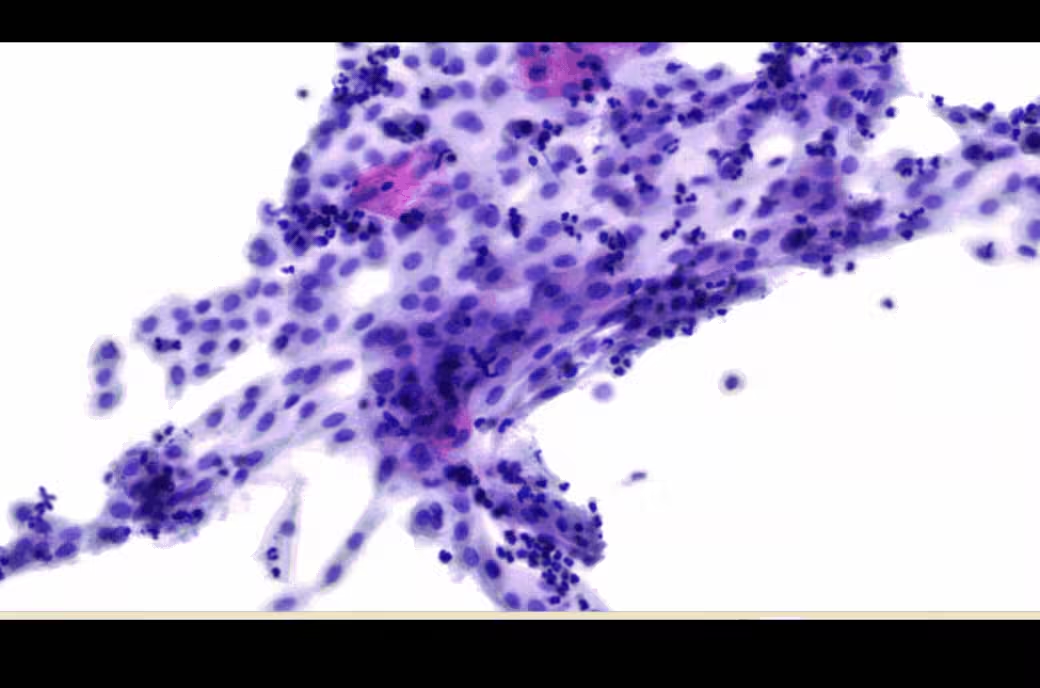
Cytology clusters are inherently three-dimensional. A flat single-plane scan misses nuclear contours, chromatin patterns, and overlapping structures.
High-performance cytology digital pathology workflows rely on variable or automated Z-stacking to recreate depth accurately.

2. High-Speed Scanning Without Compromising Quality

Cytology slides often contain large smear areas requiring extensive scanning. Systems must optimize speed so labs can maintain throughput.

3. Optical Precision and Illumination

Consistent illumination, accurate color reproduction, and high NA (numerical aperture) optics are essential to ensure diagnostically relevant detail.

4. Compression and File Handling

Cytology images generate large files—especially with stacked focus layers. Efficient compression algorithms and viewer-side rendering are key for smooth virtual microscopy.

5. AI Readiness

When developing AI in histopathology or cytology, image quality consistency is crucial. AI models require stable acquisition parameters and high-resolution imaging.

Benefits vs Limitations of Cytology WSI

Benefits

  • Remote case review through tele-pathology becomes feasible and fast

  • Easy comparison of serial samples

  • Enables teaching sets and cross-departmental review

  • Supports AI algorithm development

  • Eliminates breakage and misplacement issues

  • Enhances workflow visibility for lab managers

Limitations

  • Larger storage requirements due to Z-stacks

  • Longer scan times if not using optimized hardware

  • High image complexity requiring advanced viewers

  • Requires training for staff unfamiliar with digital pipelines

Despite these limitations, digital cytology continues to grow rapidly, especially as digital pathology companies address the unique challenges of these slides.

Compliance Considerations

Cytology WSI must align with clinical regulations, often involving:

  • Required archival periods for gynecological and non-GYN slides

  • Ensuring image traceability, audit trails, and metadata integrity

  • Following standards like DICOM for pathology

  • Maintaining secure, encrypted storage for patient data

A compliant whole slide imaging system reduces medico-legal risk by maintaining robust logging and storage integrity.

Applications of Digital Cytology

Telecytology and Second Opinions

Remote interpretation allows cyto-pathologists to support satellite centers instantly.

Quality Assurance

Digital archives allow peer review, inter-observer comparison, and proficiency testing.

Research and AI Development

Z-stacked datasets are invaluable for feature extraction and training classifiers.

Teaching and Residency Programs

Digital slides support interactive virtual microscopy for cytology students.

Routine Diagnostics

Increasingly, labs use cytology WSI for Pap smears, FNAC, and liquid-based cytology evaluations.

Affordable slide scanners are making these applications accessible even for mid-sized laboratories.

Buying Guide: How to Choose a Cytology-Capable WSI Scanner

When selecting a system, consider the following:

  • Ability to support advanced Z-stacking and focus mapping

  • High optical resolution suitable for nuclear detail

  • Fast scanning throughput to prevent workflow bottlenecks

  • Seamless integration with WSI viewers for smooth navigation

  • Compatibility with tele-pathology and remote reporting workflows

  • Storage requirements for multi-plane images

  • Whether the scanner has been validated for cytology use

  • Vendor support for AI integration and DICOM compatibility

  • Cost-effective options for labs seeking affordable slide scanners

For help choosing the right device, explore: Morphle slide scanners

Future Trends in Cytology WSI

1. Adaptive Z-Stacking

Systems will intelligently capture more layers in dense clusters and fewer in sparse areas.

2. AI-Assisted Focusing

AI-based autofocus will reduce scanning time while improving clarity.

3. Cloud-Based Cytology Archives

As bandwidth improves, more labs will centralize cytology data for telepathology.

4. Multi-modal Imaging

Combining cytology WSI with molecular and fluorescence imaging will become more common.

5. Real-Time Remote Microscopy

Hybrid models integrating live automation with stored WSI files are emerging.

Where Morphle Shines

Morphle’s scanners are engineered to meet cytology’s demands with:

  • Z-stacking support for complex cellular structures

  • High-speed scanning optimized for large smear areas

  • Smooth WSI viewer performance

  • AI-ready imaging pipelines

These capabilities help pathology labs achieve consistent results using cost-effective, reliable imaging technology.

Contact our Team for sample cytology scans.

Learn more about digital pathology and various usecases

Read More
Contact Us
Afghanistan (+93)
Albania (+355)
Algeria (+213)
American Samoa (+1-684)
Andorra (+376)
Angola (+244)
Anguilla (+1-264)
Antarctica (+672)
Antigua and Barbuda (+1-268)
Argentina (+54)
Armenia (+374)
Aruba (+297)
Australia (+61)
Austria (+43)
Azerbaijan (+994)
Bahamas (+1-242)
Bahrain (+973)
Bangladesh (+880)
Barbados (+1-246)
Belarus (+375)
Belgium (+32)
Belize (+501)
Benin (+229)
Bermuda (+1-441)
Bhutan (+975)
Bolivia (+591)
Bosnia and Herzegovina (+387)
Botswana (+267)
Brazil (+55)
British Indian Ocean Territory (+246)
Brunei (+673)
Bulgaria (+359)
Burkina Faso (+226)
Burundi (+257)
Cambodia (+855)
Cameroon (+237)
Canada (+1)
Cape Verde (+238)
Cayman Islands (+1-345)
Central African Republic (+236)
Chad (+235)
Chile (+56)
China (+86)
Christmas Island (+53)
Cocos Islands (+61)
Colombia (+57)
Comoros (+269)
Congo (DRC) (+243)
Congo (Republic) (+242)
Cook Islands (+682)
Costa Rica (+506)
Cote D'Ivoire (+225)
Croatia (+385)
Cuba (+53)
Cyprus (+357)
Czech Republic (+420)
Denmark (+45)
Djibouti (+253)
Dominica (+1-767)
Dominican Republic (+1-809 and +1-829  )
East Timor (+670)
Ecuador (+593 )
Egypt (+20)
El Salvador (+503)
Equatorial Guinea (+240)
Eritrea (+291)
Estonia (+372)
Ethiopia (+251)
Falkland Islands (+500)
Faroe Islands (+298)
Fiji (+679)
Finland (+358)
France (+33)
French Guiana (+594)
French Polynesia (+689)
Gabon (+241)
Gambia (+220)
Georgia (+995)
Germany (+49)
Ghana (+233)
Gibraltar (+350)
Greece (+30)
Greenland (+299)
Grenada (+1-473)
Guadeloupe (+590)
Guam (+1-671)
Guatemala (+502)
Guinea (+224)
Guinea-Bissau (+245)
Guyana (+592)
Haiti (+509)
Honduras (+504)
Hong Kong (+852)
Hungary (+36)
Iceland (+354)
India (+91)
Indonesia (+62)
Iran (+98)
Iraq (+964)
Ireland (+353)
Israel (+972)
Italy (+39)
Jamaica (+1-876)
Japan (+81)
Jordan (+962)
Kazakhstan (+7)
Kenya (+254)
Kiribati (+686)
Kuwait (+965)
Kyrgyzstan (+996)
Laos (+856)
Latvia (+371)
Lebanon (+961)
Lesotho (+266)
Liberia (+231)
Libya (+218)
Liechtenstein (+423)
Lithuania (+370)
Luxembourg (+352)
Macau (+853)
Macedonia (+389)
Madagascar (+261)
Malawi (+265)
Malaysia (+60)
Maldives (+960)
Mali (+223)
Malta (+356)
Marshall Islands (+692)
Martinique (+596)
Mauritania (+222)
Mauritius (+230)
Mayotte (+269)
Mexico (+52)
Micronesia (+691)
Moldova (+373)
Monaco (+377)
Mongolia (+976)
Montserrat (+1-664)
Morocco (+212)
Mozambique (+258)
Myanmar (+95)
Namibia (+264)
Nauru (+674)
Nepal (+977)
Netherlands (+31)
Netherlands Antilles (+599)
New Caledonia (+687)
New Zealand (+64)
Nicaragua (+505)
Niger (+227)
Nigeria (+234)
Niue (+683)
Norfolk Island (+672)
Northern Mariana Islands (+1-670)
North Korea (+850)
Norway (+47)
Oman (+968)
Pakistan (+92)
Palau (+680)
Palestinian State (+970)
Panama (+507)
Papua New Guinea (+675)
Paraguay (+595)
Peru (+51)
Philippines (+63)
Poland (+48)
Portugal (+351)
Puerto Rico (+1-787 or +1-939)
Qatar (+974 )
Reunion (+262)
Romania (+40)
Russia (+7)
Rwanda (+250)
Saint Helena (+290)
Saint Kitts and Nevis (+1-869)
Saint Lucia (+1-758)
Saint Pierre and Miquelon (+508)
Saint Vincent and the Grenadines (+1-784)
Samoa (+685)
San Marino (+378)
Sao Tome and Principe (+239)
Saudi Arabia (+966)
Senegal (+221)
Serbia (+381)
Seychelles (+248)
Sierra Leone (+232)
Singapore (+65)
Slovakia (+421)
Slovenia (+386)
Solomon Islands (+677)
Somalia (+252)
South Africa (+27)
South Korea (+82)
South Sudan (+211)
Spain (+34)
Sri Lanka (+94)
Sudan (+249)
Suriname (+597)
Svalbard and Jan Mayen Islands (+47)
Swaziland (+268)
Sweden (+46)
Switzerland (+41)
Syria (+963)
Taiwan (+886)
Tajikistan (+992)
Tanzania (+255)
Thailand (+66)
Togo (+228)
Tokelau (+690)
Tonga (+676)
Trinidad and Tobago (+1-868)
Tunisia (+216)
Turkey (+90)
Turkmenistan (+993)
Turks and Caicos Islands (+1-649)
Tuvalu (+688)
Uganda (+256)
Ukraine (+380)
United Arab Emirates (+971)
United Kingdom (+44)
United States (+1)
Uruguay (+598)
Uzbekistan (+998)
Vanuatu (+678)
Vatican City State (+418)
Venezuela (+58)
Vietnam (+84)
Virgin Islands, British (+1-284)
Virgin Islands, United States (+1-340)
Wallis and Futuna Islands (+681)
Western Sahara (+212)
Yemen (+967)
Zambia (+260)
Zimbabwe (+263)