Storage Planning for WSI: How Many TB Do You Need?

Whole Slide Imaging (WSI) generates massive data volumes, making storage planning a critical part of digital pathology adoption. This blog explains how to estimate WSI storage requirements by breaking down file sizes, scan resolution, compression methods, tissue area, Z-stacking, and retention policies. It explores how storage impacts daily pathology workflows, telepathology, AI in histopathology, and long-term archives. The article compares onsite, cloud, and hybrid storage strategies, outlines compliance considerations, and provides practical guidance for calculating annual terabyte needs. It also highlights how Morphle scanners support scalable, efficient storage for growing digital pathology workloads.
9 mins

Storage Planning for WSI: How Many TB Do You Need?

TL;DR

Whole Slide Imaging generates extremely large datasets. A single slide can range from a few hundred megabytes to several gigabytes depending on resolution, compression, and scanning strategy. For labs moving to a whole slide imaging system, planning storage is as important as selecting the scanner itself. This blog explains how to estimate storage requirements, what technical factors influence file size, and how Morphle helps labs scale efficiently with onsite and cloud-ready storage options.

What You’ll Learn

  • How WSI file sizes are calculated

  • What impacts storage needs in routine pathology workflows

  • How to plan for daily, monthly, and yearly storage growth

  • Trade-offs between onsite and cloud storage

  • How Morphle scanners simplify long-term storage planning

Definitions: The Terms Behind Storage Planning

Whole Slide Imaging System
A complete workflow for digitizing slides—including the digital pathology scanner, the processing engine, the WSI viewer, and the archival solution.

Digital Pathology Scanner
The device that generates WSI files by capturing the entire tissue section at high resolution.

WSI Viewer
Software that streams these large files efficiently, using pyramidal layers to make navigation smooth.

Virtual Microscopy
Viewing digital slides instead of glass slides, requiring high-performance rendering and fast storage access.

Telepathology
Remote diagnosis, which depends heavily on how quickly large images can be retrieved and streamed.

DICOM Pathology
A standardized format for storing and transmitting WSI files in clinical environments.

AI in Histopathology
Algorithms that process WSI files, often requiring uncompressed or lightly compressed images.

Workflow: Why Storage Is Central to WSI

Once a lab transitions to digital:

  1. Slides are scanned daily using a digital pathology scanner.

  2. High-resolution images are generated and stored.

  3. WSI viewers retrieve those images repeatedly during diagnosis.

  4. Telepathology workflows retrieve them remotely.

  5. AI pipelines read and reprocess the images.

  6. Long-term archives preserve them for years.

Storage touches every stage. Poor storage planning results in slow loading, viewer lag, expensive migrations, and lost clinical time.

Technical Factors That Determine Storage Size

1. Scan Resolution and Magnification

Higher resolution and higher magnification dramatically increase file sizes. A 40x scan can be 2–3× larger than a 20x scan.

2. Compression Type

JPEG compression reduces size but may affect AI workflows. JPEG2000 and pyramidal TIFF retain quality but produce larger files.

3. Tissue Area Ratio

Slides with sparse tissue occupy less space; large sections or multiple sections increase size proportionally.

4. Z-stacking

Multi-layer focus capture (Z-stacks) multiplies storage per slide.

5. File Format

DICOM pathology files may include metadata, annotations, and additional layers for AI or QC information.

6. Frequency of Access

Frequently accessed slides need fast, tier-1 storage; archives can be stored in cheaper, colder tiers.

Benefits vs. Limitations of Different Storage Strategies

Benefits of Onsite Storage

  • Instant access for diagnosis

  • Lower cost per TB over long periods

  • Full control over data governance

  • Suitable for high-volume centers

Morphle scanners provide robust onsite storage:

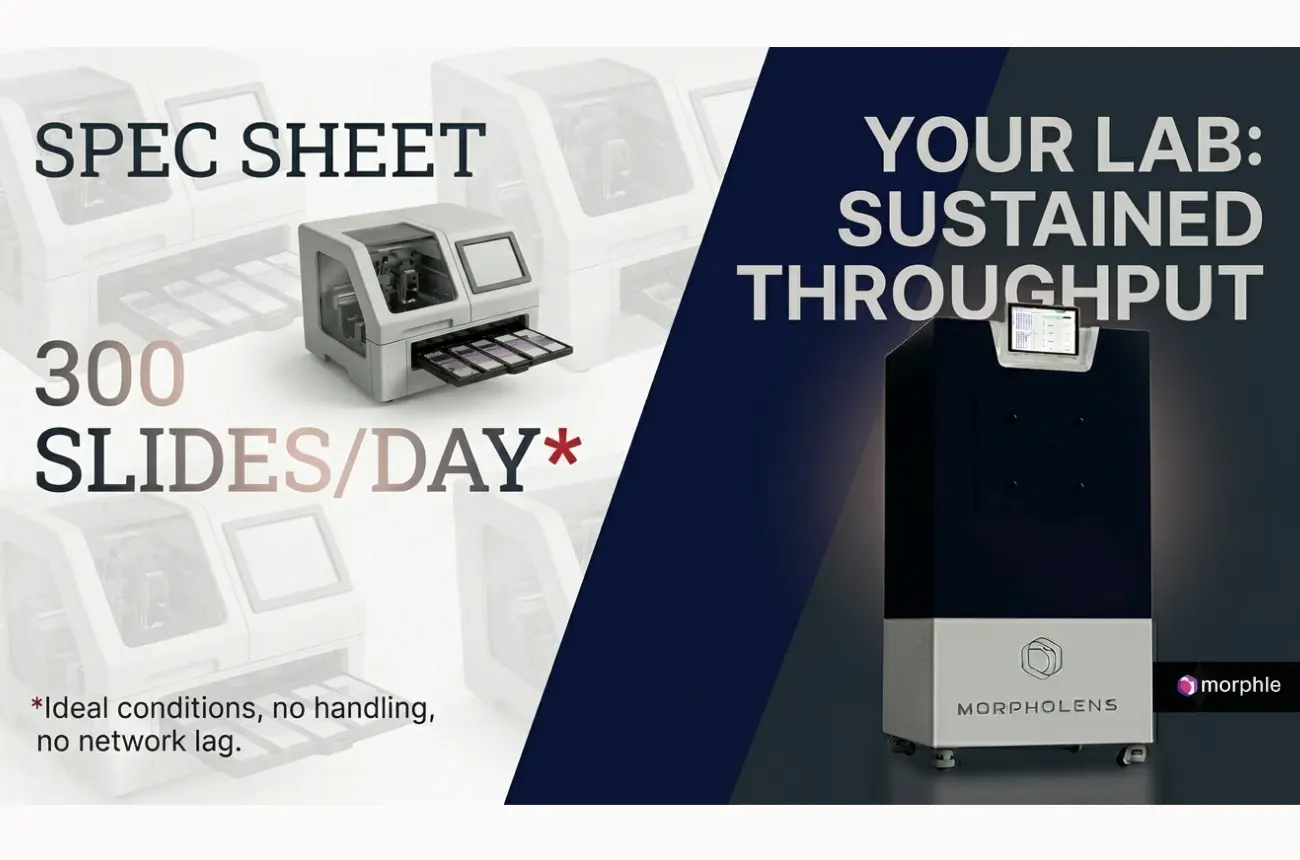
  • MorphoLens 1 and 6: store up to 3,000 scans onsite

  • MorphoLens 240: stores up to 15,000 scans onsite
    To explore the details : MorphoLens240

Limitations of Onsite Storage

  • Requires IT maintenance

  • Planning for expansion is essential

Benefits of Cloud Storage

  • Infinite scalability

  • No hardware maintenance

  • Ideal for multi-center tele-pathology workflows

Limitations of Cloud Storage

  • Ongoing subscription fees

  • Requires stable high-speed internet

Morphle supports hybrid deployment, allowing labs to pick the best combination of onsite and cloud storage.

Compliance Considerations

Healthcare imaging is governed by data protection frameworks:

  • Retention periods defined by national regulations

  • Strict rules around encrypted storage

  • Access control and audit trails

  • Chain-of-custody preservation for medico-legal cases

  • DICOM compatibility requirements

Your storage strategy must support both clinical workflow and legal obligations.

Applications: How Storage Needs Vary Across Use Cases

Routine Histopathology

Most slides stored for 3–10 years, moderate file sizes, frequent daily retrieval.

Cancer Screening Programs

Extremely high volumes; needs fast ingest and efficient compression.

Telepathology

Fast network access is essential; latency-sensitive.

Research and AI Training

Uncompressed or minimal compression files for model training; extremely storage-intensive.

Teaching and Academic Archives

Long-term preservation of curated sets, often with annotation layers.

Each of these scenarios dramatically affects the TB requirements of your whole slide imaging system.

Buying Guide: How to Estimate Your Storage Needs

To plan properly, consider the following:

  1. Scan volume per day

  2. Average file size per slide

  3. Compression method used

  4. Retention period (clinical, research, legal)

  5. How many times slides are accessed per week

  6. Need for backup or redundancy

  7. Whether AI pipelines require lossless images

  8. Onsite vs cloud distribution

Labs scanning 50–200 slides/day typically require 20–80 TB of active storage per year, depending on resolution and compression.

For help selecting the right scanner and storage tier, explore: Morphle scanner portfolio

Future Trends in WSI Storage

The next few years will bring innovations that make WSI storage smarter, cheaper, and more adaptive:

  • Predictive storage tiering that auto-moves rarely accessed slides to cold storage

  • More efficient compression algorithms optimized for WSI

  • AI-driven QC that reduces re-scans and redundant files

  • Direct-to-cloud scanning pipelines

  • Edge computing for faster diagnosis in remote or low-bandwidth settings

Storage management will increasingly become an automated, intelligent component of every whole slide imaging system.

How Morphle Helps

Morphle scanners offer built-in onsite storage optimized for real-world workloads:

  • MorphoLens 1 & 6 store up to 3,000 slides onsite

  • MorphoLens 240 stores up to 15,000 slides onsite

  • Hybrid architecture supports cloud + onsite storage

  • Optimized file handling ensures smooth streaming on the WSI viewer

  • Tele-pathology workflows remain fast and reliable even with large datasets

This ensures storage never becomes a bottleneck in your digital transformation.

Contact our Specialists to understand your storage needs.

Learn more about digital pathology and various usecases

Read More
Contact Us
Afghanistan (+93)
Albania (+355)
Algeria (+213)
American Samoa (+1-684)
Andorra (+376)
Angola (+244)
Anguilla (+1-264)
Antarctica (+672)
Antigua and Barbuda (+1-268)
Argentina (+54)
Armenia (+374)
Aruba (+297)
Australia (+61)
Austria (+43)
Azerbaijan (+994)
Bahamas (+1-242)
Bahrain (+973)
Bangladesh (+880)
Barbados (+1-246)
Belarus (+375)
Belgium (+32)
Belize (+501)
Benin (+229)
Bermuda (+1-441)
Bhutan (+975)
Bolivia (+591)
Bosnia and Herzegovina (+387)
Botswana (+267)
Brazil (+55)
British Indian Ocean Territory (+246)
Brunei (+673)
Bulgaria (+359)
Burkina Faso (+226)
Burundi (+257)
Cambodia (+855)
Cameroon (+237)
Canada (+1)
Cape Verde (+238)
Cayman Islands (+1-345)
Central African Republic (+236)
Chad (+235)
Chile (+56)
China (+86)
Christmas Island (+53)
Cocos Islands (+61)
Colombia (+57)
Comoros (+269)
Congo (DRC) (+243)
Congo (Republic) (+242)
Cook Islands (+682)
Costa Rica (+506)
Cote D'Ivoire (+225)
Croatia (+385)
Cuba (+53)
Cyprus (+357)
Czech Republic (+420)
Denmark (+45)
Djibouti (+253)
Dominica (+1-767)
Dominican Republic (+1-809 and +1-829  )
East Timor (+670)
Ecuador (+593 )
Egypt (+20)
El Salvador (+503)
Equatorial Guinea (+240)
Eritrea (+291)
Estonia (+372)
Ethiopia (+251)
Falkland Islands (+500)
Faroe Islands (+298)
Fiji (+679)
Finland (+358)
France (+33)
French Guiana (+594)
French Polynesia (+689)
Gabon (+241)
Gambia (+220)
Georgia (+995)
Germany (+49)
Ghana (+233)
Gibraltar (+350)
Greece (+30)
Greenland (+299)
Grenada (+1-473)
Guadeloupe (+590)
Guam (+1-671)
Guatemala (+502)
Guinea (+224)
Guinea-Bissau (+245)
Guyana (+592)
Haiti (+509)
Honduras (+504)
Hong Kong (+852)
Hungary (+36)
Iceland (+354)
India (+91)
Indonesia (+62)
Iran (+98)
Iraq (+964)
Ireland (+353)
Israel (+972)
Italy (+39)
Jamaica (+1-876)
Japan (+81)
Jordan (+962)
Kazakhstan (+7)
Kenya (+254)
Kiribati (+686)
Kuwait (+965)
Kyrgyzstan (+996)
Laos (+856)
Latvia (+371)
Lebanon (+961)
Lesotho (+266)
Liberia (+231)
Libya (+218)
Liechtenstein (+423)
Lithuania (+370)
Luxembourg (+352)
Macau (+853)
Macedonia (+389)
Madagascar (+261)
Malawi (+265)
Malaysia (+60)
Maldives (+960)
Mali (+223)
Malta (+356)
Marshall Islands (+692)
Martinique (+596)
Mauritania (+222)
Mauritius (+230)
Mayotte (+269)
Mexico (+52)
Micronesia (+691)
Moldova (+373)
Monaco (+377)
Mongolia (+976)
Montserrat (+1-664)
Morocco (+212)
Mozambique (+258)
Myanmar (+95)
Namibia (+264)
Nauru (+674)
Nepal (+977)
Netherlands (+31)
Netherlands Antilles (+599)
New Caledonia (+687)
New Zealand (+64)
Nicaragua (+505)
Niger (+227)
Nigeria (+234)
Niue (+683)
Norfolk Island (+672)
Northern Mariana Islands (+1-670)
North Korea (+850)
Norway (+47)
Oman (+968)
Pakistan (+92)
Palau (+680)
Palestinian State (+970)
Panama (+507)
Papua New Guinea (+675)
Paraguay (+595)
Peru (+51)
Philippines (+63)
Poland (+48)
Portugal (+351)
Puerto Rico (+1-787 or +1-939)
Qatar (+974 )
Reunion (+262)
Romania (+40)
Russia (+7)
Rwanda (+250)
Saint Helena (+290)
Saint Kitts and Nevis (+1-869)
Saint Lucia (+1-758)
Saint Pierre and Miquelon (+508)
Saint Vincent and the Grenadines (+1-784)
Samoa (+685)
San Marino (+378)
Sao Tome and Principe (+239)
Saudi Arabia (+966)
Senegal (+221)
Serbia (+381)
Seychelles (+248)
Sierra Leone (+232)
Singapore (+65)
Slovakia (+421)
Slovenia (+386)
Solomon Islands (+677)
Somalia (+252)
South Africa (+27)
South Korea (+82)
South Sudan (+211)
Spain (+34)
Sri Lanka (+94)
Sudan (+249)
Suriname (+597)
Svalbard and Jan Mayen Islands (+47)
Swaziland (+268)
Sweden (+46)
Switzerland (+41)
Syria (+963)
Taiwan (+886)
Tajikistan (+992)
Tanzania (+255)
Thailand (+66)
Togo (+228)
Tokelau (+690)
Tonga (+676)
Trinidad and Tobago (+1-868)
Tunisia (+216)
Turkey (+90)
Turkmenistan (+993)
Turks and Caicos Islands (+1-649)
Tuvalu (+688)
Uganda (+256)
Ukraine (+380)
United Arab Emirates (+971)
United Kingdom (+44)
United States (+1)
Uruguay (+598)
Uzbekistan (+998)
Vanuatu (+678)
Vatican City State (+418)
Venezuela (+58)
Vietnam (+84)
Virgin Islands, British (+1-284)
Virgin Islands, United States (+1-340)
Wallis and Futuna Islands (+681)
Western Sahara (+212)
Yemen (+967)
Zambia (+260)
Zimbabwe (+263)