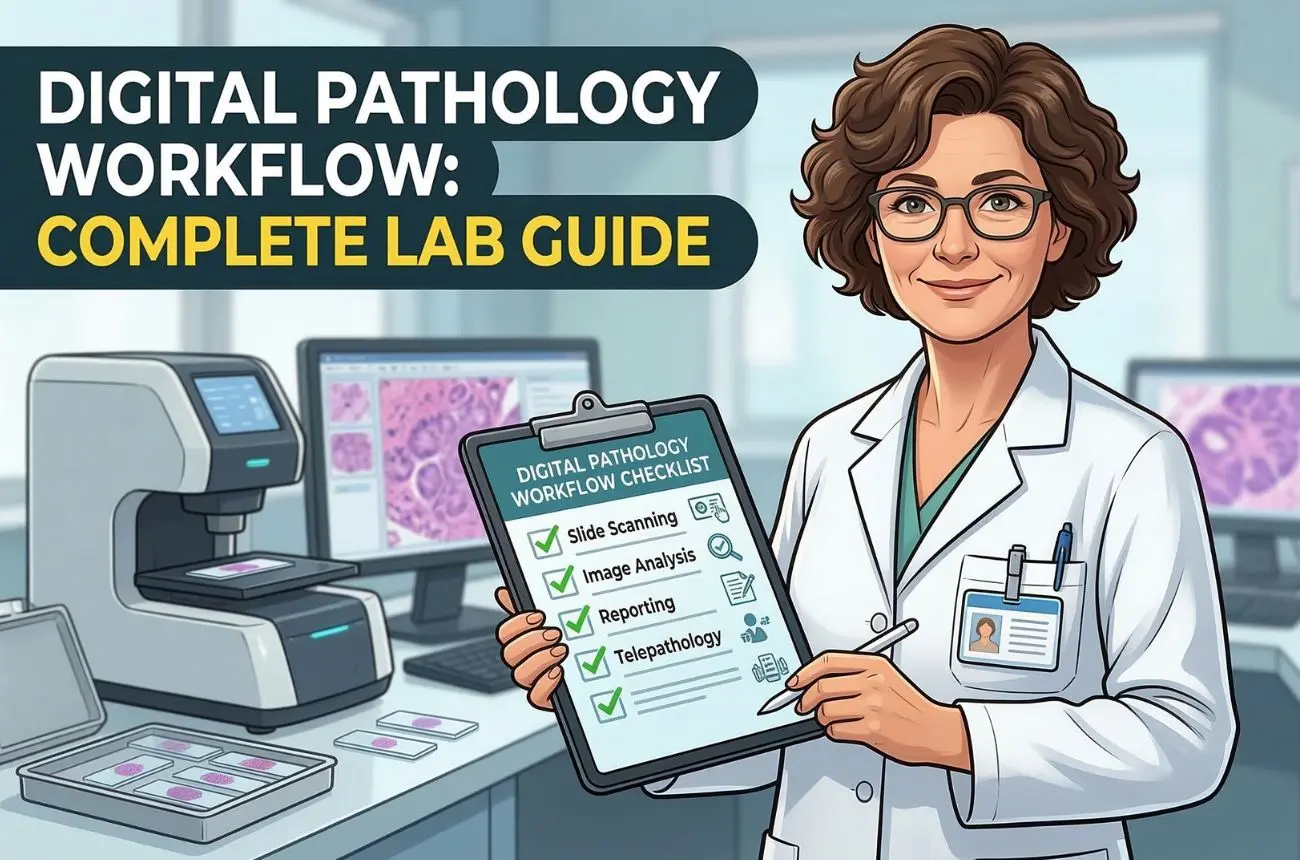
Digital Pathology Workflow: Complete Lab Guide

Everything your lab needs to digitize, streamline, and future-proof your pathology workflow.
6 mins

Digital Pathology Workflow: Complete Lab Guide

TL;DR

  • Digital pathology converts glass slides into high-resolution Whole Slide Images (WSIs) for remote review, AI analysis, and long-term archiving.

  • A well-configured digital pathology scanner is the foundation of every modern lab workflow.

  • Labs that digitize today gain faster turnarounds, fewer errors, and scalable infrastructure.

  • Morphle Labs offers end-to-end digital pathology solutions built for clinical and research environments.

What You'll Learn in This Guide

  • What digital pathology is and how the workflow operates step by step

  • The technical factors that define scanner performance

  • Benefits, limitations, and validation considerations

  • Real-world applications across clinical and research settings

  • A practical buying checklist and future trend outlook

What Is Digital Pathology?

Digital pathology is the practice of converting traditional glass microscope slides into high-resolution digital images, called Whole Slide Images (WSIs), using a digital pathology scanner. These images can then be viewed, annotated, shared, and analyzed on a computer screen, eliminating the need for physical slide transport and enabling remote diagnostics.

At its core, digital pathology replaces the eyepiece of a conventional microscope with a software-driven imaging platform. The result is a fully reproducible, shareable, and AI-compatible tissue image that integrates directly into laboratory information systems (LIS) and hospital networks.

This is not merely a convenience upgrade. It represents a fundamental transformation in how pathology labs operate.

The Digital Pathology Workflow: Step by Step

Understanding the workflow is essential before investing in infrastructure. A well-designed digital pathology workflow follows these stages:

Step 1 — Tissue Preparation

Tissue samples are collected, fixed in formalin, embedded in paraffin (FFPE), and sectioned. Sections are mounted on glass slides and stained, most commonly with Hematoxylin & Eosin (H&E) for histology or immunohistochemistry (IHC) markers for targeted diagnostics.

The quality of digital slide images is heavily influenced by preparation quality at this stage.

Step 2 — Pre-Scan Quality Check

Before scanning, slides should be reviewed for:

  • air bubbles

  • coverslip misalignment

  • staining inconsistencies

  • tissue folds

Poor-quality slides produce poor digital images. Establishing a pre-scan checklist significantly reduces rescanning time.

Step 3 — Whole Slide Scanning

This is the pivotal step. A digital pathology scanner captures the entire slide at high resolution — typically 20x or 40x magnification — creating a Whole Slide Image.

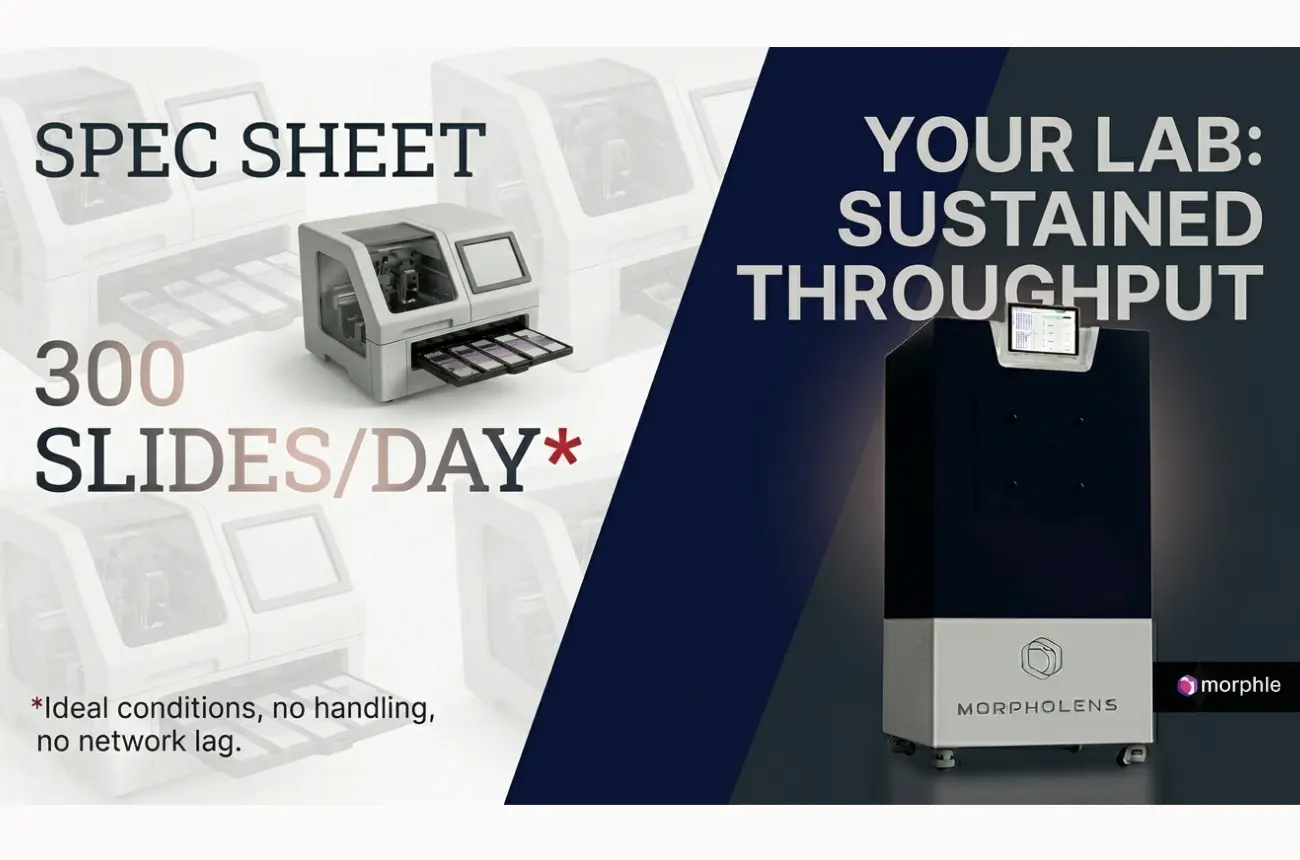
Modern automated scanners can process dozens to hundreds of slides per day, depending on system capacity.

Key performance variables include:

  • scanning speed

  • resolution (~0.25 µm/pixel at 40x)

  • autofocus reliability

  • tissue detection algorithms

Step 4 — Image Management and Storage

Whole Slide Images are large files, often 1–4 GB per slide.

An Image Management System (IMS) or digital pathology platform handles:

  • storage

  • organization

  • access control

  • retrieval

Integration with existing LIS and hospital IT infrastructure is essential for clinical deployments.

Step 5 — AI-Assisted Image Analysis

Once digitized, slides can be processed using image analysis tools for tasks such as:

  • tumor detection

  • cell counting

  • biomarker quantification

  • tissue segmentation

AI tools support pathologists by reducing repetitive tasks and highlighting regions of interest.

Step 6 — Remote Diagnosis and Reporting

Pathologists access slides through a digital viewer from any location. Diagnostic annotations and measurements are recorded within the platform and linked to case records through the LIS.

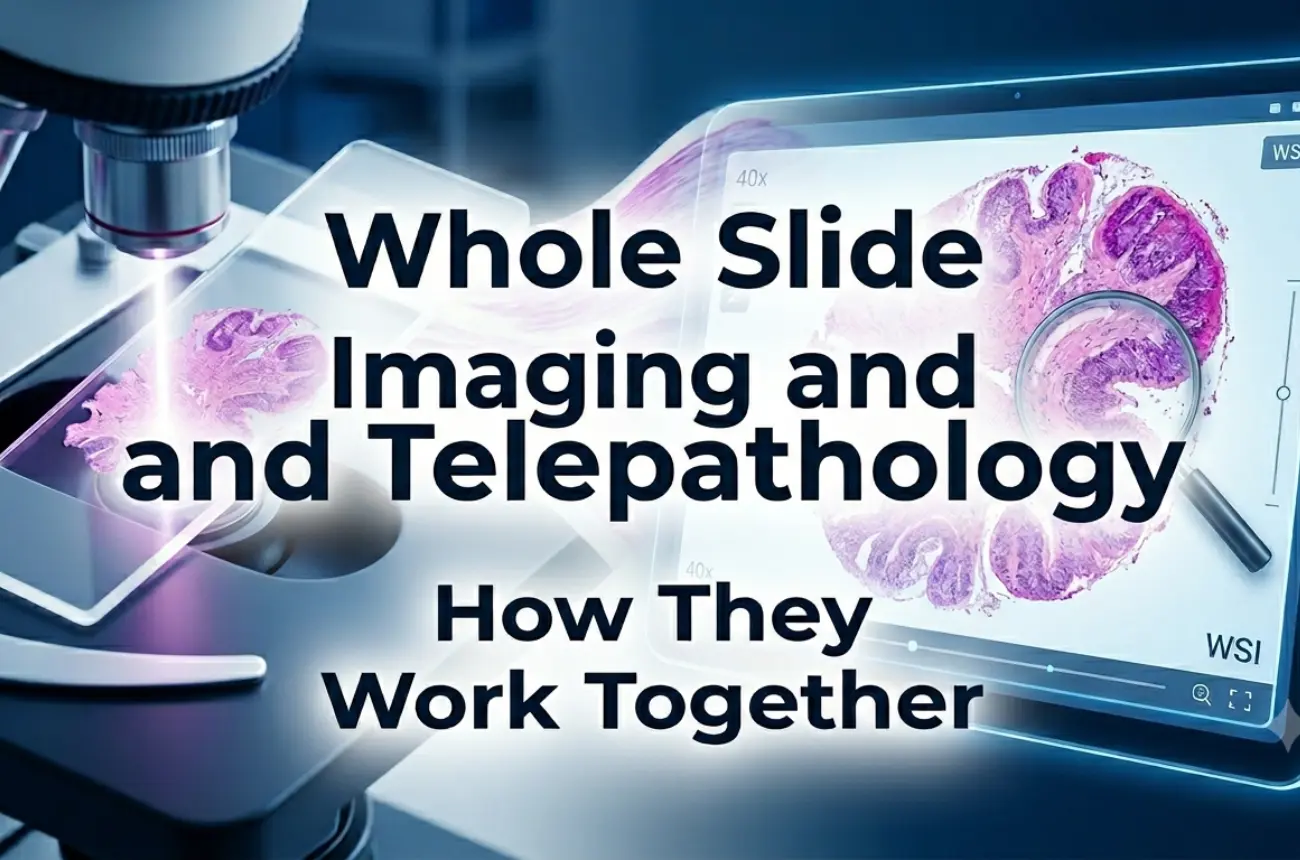
Digital workflows also enable multi-site collaboration and telepathology consultations.

Step 7 — Archiving and Quality Control

Digital slides are archived with metadata for long-term retrieval.

Automated quality control tools can flag:

  • incomplete scans

  • focus issues

  • scanning artifacts

This level of automated quality monitoring is difficult to achieve with traditional glass slide workflows.

Technical Factors That Drive Scanner Performance

Not all digital pathology scanners are equal. Before selecting one, labs should evaluate the following parameters:

Resolution & Magnification

40x scanning is sufficient for most histology workflows, and is also commonly used for cytology or detailed tissue evaluation.

Scanning Speed

High-volume labs may require scanners capable of processing 200+ slides per day without compromising image quality.

Autofocus Technology

Advanced autofocus systems are essential for maintaining consistent focus across uneven tissue sections and varying slide thickness.

File Format Compatibility

Open formats such as TIFF or DICOM allow compatibility across viewers, AI platforms, and telepathology systems.

Footprint & Integration

Compact scanners that integrate easily into existing workflows are increasingly preferred in space-constrained laboratories.

Connectivity

API access and interoperability with laboratory systems determine how easily scanners integrate into hospital IT environments.

To learn more Visit Whole Slide Imaging System: Clinical vs Research Use

Benefits vs Limitations

Benefits

  • Faster turnaround time : Digital slides are accessible immediately after scanning

  • Remote and multidisciplinary revie : experts can collaborate across locations

  • AI-enabled image analysis

  • Reduced risk of glass slide damage or loss

  • Improved quality control through automated scan monitoring

  • Permanent digital archives for research and education

Limitations

  • Initial infrastructure investment for scanners and storage systems

  • Large WSI file sizes requiring scalable storage solutions

  • Validation and workflow adaptation during implementation

  • Training requirements for pathologists and laboratory staff

Regulatory and Validation Considerations

Digital pathology deployments must align with regional regulatory frameworks and laboratory validation protocols.

In Europe, digital pathology systems used in diagnostic workflows may carry CE-IVDR certification. In India, medical imaging systems may fall under CDSCO regulatory oversight depending on their intended clinical use.

In addition to regulatory certification, clinical laboratories typically perform internal validation studies to demonstrate concordance between digital and conventional microscopy before adopting whole slide imaging for routine diagnostic workflows.

Professional organizations such as the College of American Pathologists (CAP) and the Digital Pathology Association (DPA) provide guidelines for digital pathology validation.

Data protection regulations — including HIPAA, GDPR, and local privacy laws — govern how digital slide data is stored, transmitted, and accessed.

Real-World Applications

Clinical Diagnostics

Digital pathology is increasingly used for:

  • Surgical pathology case review

  • Tumor board presentations

  • Telepathology consultations

  • Multi-site diagnostic collaboration

Digital scanning helps reduce delays when slides must be reviewed by specialists across institutions.

Research & Biomarker Studies

Research institutions use digital pathology to:

  • Build annotated tissue datasets

  • Conduct multi-site clinical trials

  • Quantify biomarker expression

  • Train AI models on large WSI libraries

Digital slides provide reproducible image data suitable for computational analysis.

Education & Training

Medical schools and pathology training programs rely on digital slide libraries to expose students to diverse case types.

Digital WSI collections are:

  • Searchable

  • Reusable

  • Easily shared across institutions

Scanner Buying Checklist

Before selecting a digital pathology scanner, evaluate the following:

✓ Throughput — how many slides per day does your lab process?

✓ Resolution — does your workflow require 20x, 40x, or both?

✓ Validation readiness — does the vendor support clinical validation protocols?

✓ LIS/PACS integration — compatibility with existing hospital systems

✓ AI compatibility — ability to integrate with image analysis tools

✓ Total cost of ownership — storage, maintenance, and software licensing

✓ Service support — response times and geographic coverage

✓ Scalability — ability to grow with your lab's volume over time

Future Trends in Digital Pathology

Several developments are shaping the next generation of digital pathology infrastructure:

AI-Driven Diagnostics

Machine learning models trained on large WSI datasets are increasingly assisting pathologists in tasks such as tumor detection and biomarker quantification.

Federated Learning

Multi-institution collaborations are enabling AI model training without sharing raw patient data.

Multimodal Diagnostics

Pathology images are increasingly analyzed alongside genomics, radiology, and clinical data.

Expanding Global Access

More affordable scanning technologies are making digital pathology accessible to smaller labs and emerging healthcare systems worldwide.

Why Morphle Labs?

Morphle Labs focuses on building accessible, high-performance digital pathology infrastructure designed for modern laboratory workflows.

Morphle scanners support:

  • High-throughput brightfield whole slide imaging

  • Integration with LIS and laboratory IT systems

  • Open image formats compatible with AI platforms

  • Scalable deployments for clinical and research environments

Built in India and deployed globally, Morphle solutions combine competitive pricing with enterprise-grade performance, enabling institutions to transition toward fully digital pathology workflows.

Ready to Digitize Your Lab?

Digital pathology is rapidly becoming the standard for modern diagnostic and research laboratories.

Labs adopting digital workflows gain faster collaboration, improved data management, and access to emerging AI-assisted diagnostics.

Morphle Labs can help guide your transition — from scanner selection and workflow planning to full digital pathology deployment.

👉 Book a consultation with the Morphle Labs team today.

Visit morphle.com to request a demo and explore how digital pathology can transform your lab workflow.

Learn more about digital pathology and various usecases

Read More
Contact Us
Afghanistan (+93)
Albania (+355)
Algeria (+213)
American Samoa (+1-684)
Andorra (+376)
Angola (+244)
Anguilla (+1-264)
Antarctica (+672)
Antigua and Barbuda (+1-268)
Argentina (+54)
Armenia (+374)
Aruba (+297)
Australia (+61)
Austria (+43)
Azerbaijan (+994)
Bahamas (+1-242)
Bahrain (+973)
Bangladesh (+880)
Barbados (+1-246)
Belarus (+375)
Belgium (+32)
Belize (+501)
Benin (+229)
Bermuda (+1-441)
Bhutan (+975)
Bolivia (+591)
Bosnia and Herzegovina (+387)
Botswana (+267)
Brazil (+55)
British Indian Ocean Territory (+246)
Brunei (+673)
Bulgaria (+359)
Burkina Faso (+226)
Burundi (+257)
Cambodia (+855)
Cameroon (+237)
Canada (+1)
Cape Verde (+238)
Cayman Islands (+1-345)
Central African Republic (+236)
Chad (+235)
Chile (+56)
China (+86)
Christmas Island (+53)
Cocos Islands (+61)
Colombia (+57)
Comoros (+269)
Congo (DRC) (+243)
Congo (Republic) (+242)
Cook Islands (+682)
Costa Rica (+506)
Cote D'Ivoire (+225)
Croatia (+385)
Cuba (+53)
Cyprus (+357)
Czech Republic (+420)
Denmark (+45)
Djibouti (+253)
Dominica (+1-767)
Dominican Republic (+1-809 and +1-829  )
East Timor (+670)
Ecuador (+593 )
Egypt (+20)
El Salvador (+503)
Equatorial Guinea (+240)
Eritrea (+291)
Estonia (+372)
Ethiopia (+251)
Falkland Islands (+500)
Faroe Islands (+298)
Fiji (+679)
Finland (+358)
France (+33)
French Guiana (+594)
French Polynesia (+689)
Gabon (+241)
Gambia (+220)
Georgia (+995)
Germany (+49)
Ghana (+233)
Gibraltar (+350)
Greece (+30)
Greenland (+299)
Grenada (+1-473)
Guadeloupe (+590)
Guam (+1-671)
Guatemala (+502)
Guinea (+224)
Guinea-Bissau (+245)
Guyana (+592)
Haiti (+509)
Honduras (+504)
Hong Kong (+852)
Hungary (+36)
Iceland (+354)
India (+91)
Indonesia (+62)
Iran (+98)
Iraq (+964)
Ireland (+353)
Israel (+972)
Italy (+39)
Jamaica (+1-876)
Japan (+81)
Jordan (+962)
Kazakhstan (+7)
Kenya (+254)
Kiribati (+686)
Kuwait (+965)
Kyrgyzstan (+996)
Laos (+856)
Latvia (+371)
Lebanon (+961)
Lesotho (+266)
Liberia (+231)
Libya (+218)
Liechtenstein (+423)
Lithuania (+370)
Luxembourg (+352)
Macau (+853)
Macedonia (+389)
Madagascar (+261)
Malawi (+265)
Malaysia (+60)
Maldives (+960)
Mali (+223)
Malta (+356)
Marshall Islands (+692)
Martinique (+596)
Mauritania (+222)
Mauritius (+230)
Mayotte (+269)
Mexico (+52)
Micronesia (+691)
Moldova (+373)
Monaco (+377)
Mongolia (+976)
Montserrat (+1-664)
Morocco (+212)
Mozambique (+258)
Myanmar (+95)
Namibia (+264)
Nauru (+674)
Nepal (+977)
Netherlands (+31)
Netherlands Antilles (+599)
New Caledonia (+687)
New Zealand (+64)
Nicaragua (+505)
Niger (+227)
Nigeria (+234)
Niue (+683)
Norfolk Island (+672)
Northern Mariana Islands (+1-670)
North Korea (+850)
Norway (+47)
Oman (+968)
Pakistan (+92)
Palau (+680)
Palestinian State (+970)
Panama (+507)
Papua New Guinea (+675)
Paraguay (+595)
Peru (+51)
Philippines (+63)
Poland (+48)
Portugal (+351)
Puerto Rico (+1-787 or +1-939)
Qatar (+974 )
Reunion (+262)
Romania (+40)
Russia (+7)
Rwanda (+250)
Saint Helena (+290)
Saint Kitts and Nevis (+1-869)
Saint Lucia (+1-758)
Saint Pierre and Miquelon (+508)
Saint Vincent and the Grenadines (+1-784)
Samoa (+685)
San Marino (+378)
Sao Tome and Principe (+239)
Saudi Arabia (+966)
Senegal (+221)
Serbia (+381)
Seychelles (+248)
Sierra Leone (+232)
Singapore (+65)
Slovakia (+421)
Slovenia (+386)
Solomon Islands (+677)
Somalia (+252)
South Africa (+27)
South Korea (+82)
South Sudan (+211)
Spain (+34)
Sri Lanka (+94)
Sudan (+249)
Suriname (+597)
Svalbard and Jan Mayen Islands (+47)
Swaziland (+268)
Sweden (+46)
Switzerland (+41)
Syria (+963)
Taiwan (+886)
Tajikistan (+992)
Tanzania (+255)
Thailand (+66)
Togo (+228)
Tokelau (+690)
Tonga (+676)
Trinidad and Tobago (+1-868)
Tunisia (+216)
Turkey (+90)
Turkmenistan (+993)
Turks and Caicos Islands (+1-649)
Tuvalu (+688)
Uganda (+256)
Ukraine (+380)
United Arab Emirates (+971)
United Kingdom (+44)
United States (+1)
Uruguay (+598)
Uzbekistan (+998)
Vanuatu (+678)
Vatican City State (+418)
Venezuela (+58)
Vietnam (+84)
Virgin Islands, British (+1-284)
Virgin Islands, United States (+1-340)
Wallis and Futuna Islands (+681)
Western Sahara (+212)
Yemen (+967)
Zambia (+260)
Zimbabwe (+263)