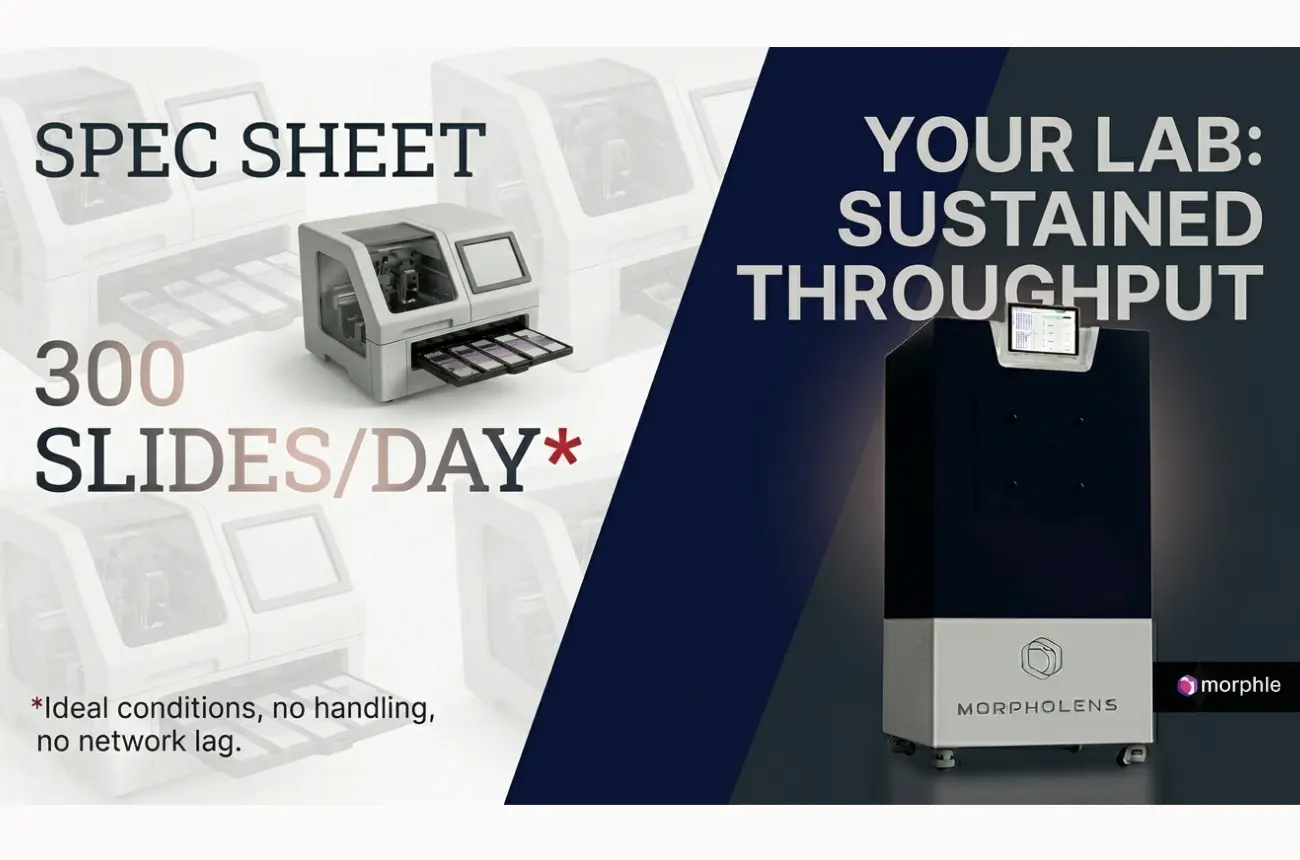
Digital Pathology Scanner Myths Debunked

Uncover the truth behind common digital pathology scanner myths. Learn what truly impacts image quality, workflow performance, and smart whole slide scanning decisions.
3 mins

Digital Pathology Scanner Myths Debunked

TL;DR

Digital pathology has evolved rapidly, yet many outdated myths continue to shape how labs evaluate scanners. Misconceptions about resolution, AI, color accuracy, and file size often mislead decision-makers; sometimes causing them to overpay or underutilize their systems. This article debunks the most persistent myths surrounding the digital pathology scanner, drawing from industry research and real-world lab experiences to clarify what truly matters in modern whole slide scanning.

What You’ll Learn

  • The top misconceptions about digital pathology scanners

  • Why resolution, magnification, and file size aren’t the whole story

  • How AI workflows influence scanner choice

  • What impacts diagnostic quality in whole slide scanning

  • How to avoid costly mistakes when evaluating systems

Definitions: Key Terms Related to Scanner Myths

Digital Pathology Scanner
A device that captures high-resolution digital images of glass slides for diagnosis, telepathology, teaching, and AI.

Whole Slide Scanner / Whole Slide Scanning
Automated capture of the entire tissue section, producing a navigable, zoomable image.

Slide Scanner Histology / Pathology Slide Scanner / Microscope Scanner / Histology Scanner
Terminology variations used by digital pathology companies to describe scanners designed for different tissue types and workflows.

Digital Pathology Scanner Price
The complete cost of ownership; not just the hardware, but software, storage, uptime, support, and workflow savings.

Workflow: How Myths Arise in Real-World Use

Digital pathology adoption often begins with assumptions from the microscopy world:

  • If 40x is great under the microscope, 40x scanning must always be superior.

  • Higher file size must mean better quality.

  • AI needs ultra-high resolution to work well.

  • All scanners from digital pathology companies produce similar output at the same magnification.

  • Automation reduces control over focus and image accuracy.

These assumptions persist because early WSI systems had limitations that modern scanners have long overcome.

Today, a digital pathology scanner is defined not just by magnification; but by optics, focus accuracy, illumination, processing, and workflow integration.

Technical Factors: Myths Debunked

Myth 1: “Higher Magnification Always Equals Higher Quality”

Reality: Magnification alone does not guarantee clarity; but a well-engineered 40x scan almost always outperforms 20x when supported by strong optics and focus precision.

Many labs mistakenly believe that 40x scans can be unreliable, when in truth, the problem lies not in magnification but in the scanner’s optical and mechanical design. Poor optics, weak autofocus, or uneven illumination can make any scan look bad, even at 40x.

When delivered through a high-quality digital pathology system, 40x reveals nuclear detail, chromatin texture, and subtle morphological cues that 20x simply cannot capture.

True diagnostic quality at 40x depends on:

  • numerical aperture

  • advanced autofocus mapping

  • precise stitching accuracy

  • optimized pixel size

  • strong dynamic range

A whole slide scanner built with robust optical engineering proves that 40x magnification—when executed correctly—is not just high quality, but diagnostically superior.

Myth 2: “Digital Slides Are Flat and Miss Depth Details”

Early scanners struggled with uneven samples, especially cytology.
Modern automated microscope slide scanners use multi-focus mapping and optional Z-stacking to deliver depth-rich imaging that often surpasses optical microscopy in consistency.

Myth 3: “AI Requires the Highest Possible Resolution”

Research shows that most AI models rely more on consistency (color, staining, noise, focus) than on extreme resolution.
Ultra-high-magnification files increase storage without necessarily increasing AI accuracy.

AI in histopathology performs best with stable, standardized whole slide scanning—not the largest pixel count.

Myth 4: “Bigger File Size Means Better Image Quality”

Compression does not equal quality loss.
Smart compression algorithms preserve detail while optimizing bandwidth and storage.
A highly optimized digital pathology scanner performs intelligent processing to maintain clarity at manageable sizes.

Myth 5: “All Scanners Are the Same If They Scan at 20x or 40x”

No two scanners produce identical results.
Differences in optics, sensors, lighting, color calibration, and stitching create significant variation.
Two whole slide scanners with the same magnification can produce dramatically different visual outcomes.

Choosing based on magnification alone is a critical—and costly—mistake.

Benefits vs Limitations of Understanding the Myths

Benefits

  • Better budgeting for Digital Pathology Scanner price

  • Improved diagnostic accuracy and confidence

  • Smarter integration of telepathology workflows

  • Reduced storage and IT overhead

  • Better alignment of scanning strategy with lab needs

Limitations If Myths Persist

  • Overspending on unnecessary scanner features

  • Underinvesting in optics or viewer performance

  • Choosing systems with poor uptime or inconsistent focus

  • Misjudging AI-readiness

Understanding scanner myths ensures your digital pathology workflow remains future-proof.

Compliance: Why Myth-Free Evaluation Matters

When submitting digital pathology systems for validation:

  • focus consistency

  • color accuracy

  • reproducibility

  • metadata integrity

  • traceability

all matter far more than magnification alone.

Regulators and auditors rely on clinical equivalence, not spec sheet numbers. A validated digital pathology scanner must demonstrate quality under real-world tissue variability; not theoretical resolution claims.

Applications: Where the Myths Matter Most

Primary Diagnosis

Myths around magnification can cause over- or under-selection of scanners.

Telepathology

File size myths can lead to bandwidth bottlenecks and slow remote review.

Teaching and Tumor Boards

Color accuracy and viewer smoothness matter more than extreme magnification.

AI Development

AI consistency myths may lead labs to choose impractically large image formats.

High-Volume Histology Workflows

Speed, reliability, and low rejection rates influence ROI more than any single spec.

Buying Guide: What Actually Matters When Choosing a Scanner

When selecting a scanner from digital pathology companies, evaluate:

  • Effective resolution (not just 20x/40x claims)

  • Optical quality and illumination uniformity

  • Color calibration reliability

  • Autofocus robustness

  • Stitching accuracy

  • Viewer performance at maximum zoom

  • File size vs. clarity

  • Total Digital Pathology Scanner price

  • Uptime and maintenance expectations

Need help choosing? Start HERE

Future Trends: Resolution Will Become Intelligent, Not Exaggerated

Expect advancements like:

  • AI-guided adaptive resolution

  • Predictive focus mapping

  • Compression algorithms tuned specifically for pathology

  • Real-time rendering that eliminates viewer lag

  • Hybrid multi-resolution scanning

The future is not “more pixels.”
It’s smarter pixels; and smarter scanning.

How Morphle Helps Debunk the Myths

Morphle scanners consistently demonstrate that:

  • True clarity comes from engineering; not magnification marketing.

  • Optical precision, lighting control, and focus algorithms matter more than spec sheet numbers.

  • Lightweight but highly optimized files can still deliver exceptional diagnostic detail.

  • AI workflows require consistency, not extreme file sizes.

  • Whole slide scanning quality depends on calibration, color balance, and stitching; not resolution myths.

Morphle’s engineering approach directly challenges outdated beliefs by prioritizing real diagnostic clarity, speed, uptime, and reliability over inflated resolution claims.

Choose a scanner which is right for you  talk to the experts

Learn more about digital pathology and various usecases

Read More
Contact Us
Afghanistan (+93)
Albania (+355)
Algeria (+213)
American Samoa (+1-684)
Andorra (+376)
Angola (+244)
Anguilla (+1-264)
Antarctica (+672)
Antigua and Barbuda (+1-268)
Argentina (+54)
Armenia (+374)
Aruba (+297)
Australia (+61)
Austria (+43)
Azerbaijan (+994)
Bahamas (+1-242)
Bahrain (+973)
Bangladesh (+880)
Barbados (+1-246)
Belarus (+375)
Belgium (+32)
Belize (+501)
Benin (+229)
Bermuda (+1-441)
Bhutan (+975)
Bolivia (+591)
Bosnia and Herzegovina (+387)
Botswana (+267)
Brazil (+55)
British Indian Ocean Territory (+246)
Brunei (+673)
Bulgaria (+359)
Burkina Faso (+226)
Burundi (+257)
Cambodia (+855)
Cameroon (+237)
Canada (+1)
Cape Verde (+238)
Cayman Islands (+1-345)
Central African Republic (+236)
Chad (+235)
Chile (+56)
China (+86)
Christmas Island (+53)
Cocos Islands (+61)
Colombia (+57)
Comoros (+269)
Congo (DRC) (+243)
Congo (Republic) (+242)
Cook Islands (+682)
Costa Rica (+506)
Cote D'Ivoire (+225)
Croatia (+385)
Cuba (+53)
Cyprus (+357)
Czech Republic (+420)
Denmark (+45)
Djibouti (+253)
Dominica (+1-767)
Dominican Republic (+1-809 and +1-829  )
East Timor (+670)
Ecuador (+593 )
Egypt (+20)
El Salvador (+503)
Equatorial Guinea (+240)
Eritrea (+291)
Estonia (+372)
Ethiopia (+251)
Falkland Islands (+500)
Faroe Islands (+298)
Fiji (+679)
Finland (+358)
France (+33)
French Guiana (+594)
French Polynesia (+689)
Gabon (+241)
Gambia (+220)
Georgia (+995)
Germany (+49)
Ghana (+233)
Gibraltar (+350)
Greece (+30)
Greenland (+299)
Grenada (+1-473)
Guadeloupe (+590)
Guam (+1-671)
Guatemala (+502)
Guinea (+224)
Guinea-Bissau (+245)
Guyana (+592)
Haiti (+509)
Honduras (+504)
Hong Kong (+852)
Hungary (+36)
Iceland (+354)
India (+91)
Indonesia (+62)
Iran (+98)
Iraq (+964)
Ireland (+353)
Israel (+972)
Italy (+39)
Jamaica (+1-876)
Japan (+81)
Jordan (+962)
Kazakhstan (+7)
Kenya (+254)
Kiribati (+686)
Kuwait (+965)
Kyrgyzstan (+996)
Laos (+856)
Latvia (+371)
Lebanon (+961)
Lesotho (+266)
Liberia (+231)
Libya (+218)
Liechtenstein (+423)
Lithuania (+370)
Luxembourg (+352)
Macau (+853)
Macedonia (+389)
Madagascar (+261)
Malawi (+265)
Malaysia (+60)
Maldives (+960)
Mali (+223)
Malta (+356)
Marshall Islands (+692)
Martinique (+596)
Mauritania (+222)
Mauritius (+230)
Mayotte (+269)
Mexico (+52)
Micronesia (+691)
Moldova (+373)
Monaco (+377)
Mongolia (+976)
Montserrat (+1-664)
Morocco (+212)
Mozambique (+258)
Myanmar (+95)
Namibia (+264)
Nauru (+674)
Nepal (+977)
Netherlands (+31)
Netherlands Antilles (+599)
New Caledonia (+687)
New Zealand (+64)
Nicaragua (+505)
Niger (+227)
Nigeria (+234)
Niue (+683)
Norfolk Island (+672)
Northern Mariana Islands (+1-670)
North Korea (+850)
Norway (+47)
Oman (+968)
Pakistan (+92)
Palau (+680)
Palestinian State (+970)
Panama (+507)
Papua New Guinea (+675)
Paraguay (+595)
Peru (+51)
Philippines (+63)
Poland (+48)
Portugal (+351)
Puerto Rico (+1-787 or +1-939)
Qatar (+974 )
Reunion (+262)
Romania (+40)
Russia (+7)
Rwanda (+250)
Saint Helena (+290)
Saint Kitts and Nevis (+1-869)
Saint Lucia (+1-758)
Saint Pierre and Miquelon (+508)
Saint Vincent and the Grenadines (+1-784)
Samoa (+685)
San Marino (+378)
Sao Tome and Principe (+239)
Saudi Arabia (+966)
Senegal (+221)
Serbia (+381)
Seychelles (+248)
Sierra Leone (+232)
Singapore (+65)
Slovakia (+421)
Slovenia (+386)
Solomon Islands (+677)
Somalia (+252)
South Africa (+27)
South Korea (+82)
South Sudan (+211)
Spain (+34)
Sri Lanka (+94)
Sudan (+249)
Suriname (+597)
Svalbard and Jan Mayen Islands (+47)
Swaziland (+268)
Sweden (+46)
Switzerland (+41)
Syria (+963)
Taiwan (+886)
Tajikistan (+992)
Tanzania (+255)
Thailand (+66)
Togo (+228)
Tokelau (+690)
Tonga (+676)
Trinidad and Tobago (+1-868)
Tunisia (+216)
Turkey (+90)
Turkmenistan (+993)
Turks and Caicos Islands (+1-649)
Tuvalu (+688)
Uganda (+256)
Ukraine (+380)
United Arab Emirates (+971)
United Kingdom (+44)
United States (+1)
Uruguay (+598)
Uzbekistan (+998)
Vanuatu (+678)
Vatican City State (+418)
Venezuela (+58)
Vietnam (+84)
Virgin Islands, British (+1-284)
Virgin Islands, United States (+1-340)
Wallis and Futuna Islands (+681)
Western Sahara (+212)
Yemen (+967)
Zambia (+260)
Zimbabwe (+263)